PHILOSOPHYFeb 16, 2026
Why We Always Keep Asking "Why?"
There's this weird moment in life when you stop and wonder why we're even doing what we're doing. It's this unending loop of questioning reality and meaning. You think you've got it figured out, but then another "why" pops up.

Raymond
Reality Designer
2min
You know what's kind of funny? We spend so much time and energy trying to understand everything, and at some point, it all just loops back to the same question: "Why?" Why are we doing any of this? And I don't just mean the big stuff, like why we're here on this spinning rock in space, but also the little things, like why we even bother getting out of bed in the morning. It seems simple, right? But the more you think about it, the more complex it gets, almost like the universe is playing some cosmic joke.
The "why" never gets truly answered because each answer leads to another question. It's like this infinite chain, and maybe that's the real point. This constant questioning. It's the drive that keeps us moving forward, exploring, building, creating. But why does it matter so much? Without it, aren't we just kind of stagnant? You can't help but see how deeply tied this is to our understanding of reality and, more personally, our reality designPOST, which we often construct without even noticing.
I've noticed that every time I think I've cracked the code on something, be it tech-related or personal philosophy, there's this nagging feeling that maybe I'm just scratching the surface. It's almost like a feedback loop. You realize one thing, and it immediately opens three more doors and each door is another path toward understanding, but also towards more questions. It's wild how our brains work like that, always at the edge of knowing and not knowing. I mean, it's exhausting but it's also invigorating.
Consider the rise of AI and how it's reshaping our conception of knowledge and reality. We build these machines to answer our questions faster and more efficiently, but they end up presenting entirely new questions we hadn't even considered before. Like, we can now ask AI to solve problems, but can it ever truly grasp the "why" behind human curiosity? Or is it destined to be an endless chase of inputs and outputs? Despite the usefulness, there's a layer of reality right there, one that's been designed and iterated on through each technological leap we've made. That thread connects back to how we perceive and interact with everything around us.
This reminds me of this time I was having a conversation with my friend Mike. We were talking about how we've been influenced by the music we've grown up with, how every song feels like it's trying to answer some kind of existential question. Yet, more often than not, it's the questions that keep us engaged, not the answers. Mike said something that stuck with me: "The moment a song makes total sense, it kind of loses its magic." Maybe it's the unresolved notes that keep the melody in our minds, like how unresolved questions keep us thinking.
There's also this cultural component of questioning that's tied to creativity. The most innovative creators, the ones pushing boundaries in art, design, and tech, seem to thrive on not having all the answers. It's almost as if ambiguity is their oxygen. The unknown isn't just a fear to conquer; it's fuel to create. That ability to sit comfortably in the unknown is what sparks new creations and drives innovation. But is there a balance? How much questioning is too much before it becomes paralyzing? Or is that even a thing?
You know how when you're designing something new, be it a piece of software or a piece of art, you have to question everything about its existence? Why are you making it? Who's it for? What problem does it solve, if any? And in the process, you end up learning not just about the project, but about yourself. It's like through making something, you're simultaneously deconstructing parts of your identity and reconstructing them in a new form. Those questions shape the end result.
And then there's consciousness. Who's actually behind the wheel? Our brains are wild landscapes, full of connections we barely comprehend. Neuroscience tries to map it all out, but consciousness itself remains elusive. We experience things through this filter of perception, which is unique to each of us. It's weird to think about how our interpretation of reality is so subjective, and how that drives the questions we ask. Could this be why we're so endlessly fascinated with consciousness? Maybe understanding it feels like the ultimate "why."
The moment a song makes total sense, it kind of loses its magic. Maybe.
Sometimes, I wonder if we're overcomplicating things. Like, if we're too caught up in finding answers instead of appreciating the mystery itself. But then, isn't the complication part of the charm? You solve one problem, and boom, three more pop up. It's almost a guarantee. And maybe that's something we lean into, for better or worse. It keeps us on our toes, prevents us from becoming complacent. PsychologyPOST shows this could be why uncertainty can be such a strong motivator.
But what about when the questions become more of a burden than an inspiration? There are times when you're just stuck because the "why" is too paralyzing to move past. I think about how often people change careers or drop projects because the question of "why am I doing this?" doesn't just linger, it gnaws at them until there's nothing left to do but walk away. It's an interesting tension. On one hand, questioning drives us forward. On the other, it can trap us in the very uncertainty we sought to explore.
And there's this wild idea that maybe the question isn't the problem. Maybe it's the fear that we won't like the answer we find. This brings us back to our personal realities, the narrative we tell ourselves. Ignorance is bliss, but is it real freedom? Or does true freedom lie in constant questioning, regardless of the discomfort it might bring? For the relentless seekers, it's almost like addiction, a craving for understanding that never really gets satisfied. ConsciousnessPOST exploration often leads there, suggesting the real journey is more internal than external.
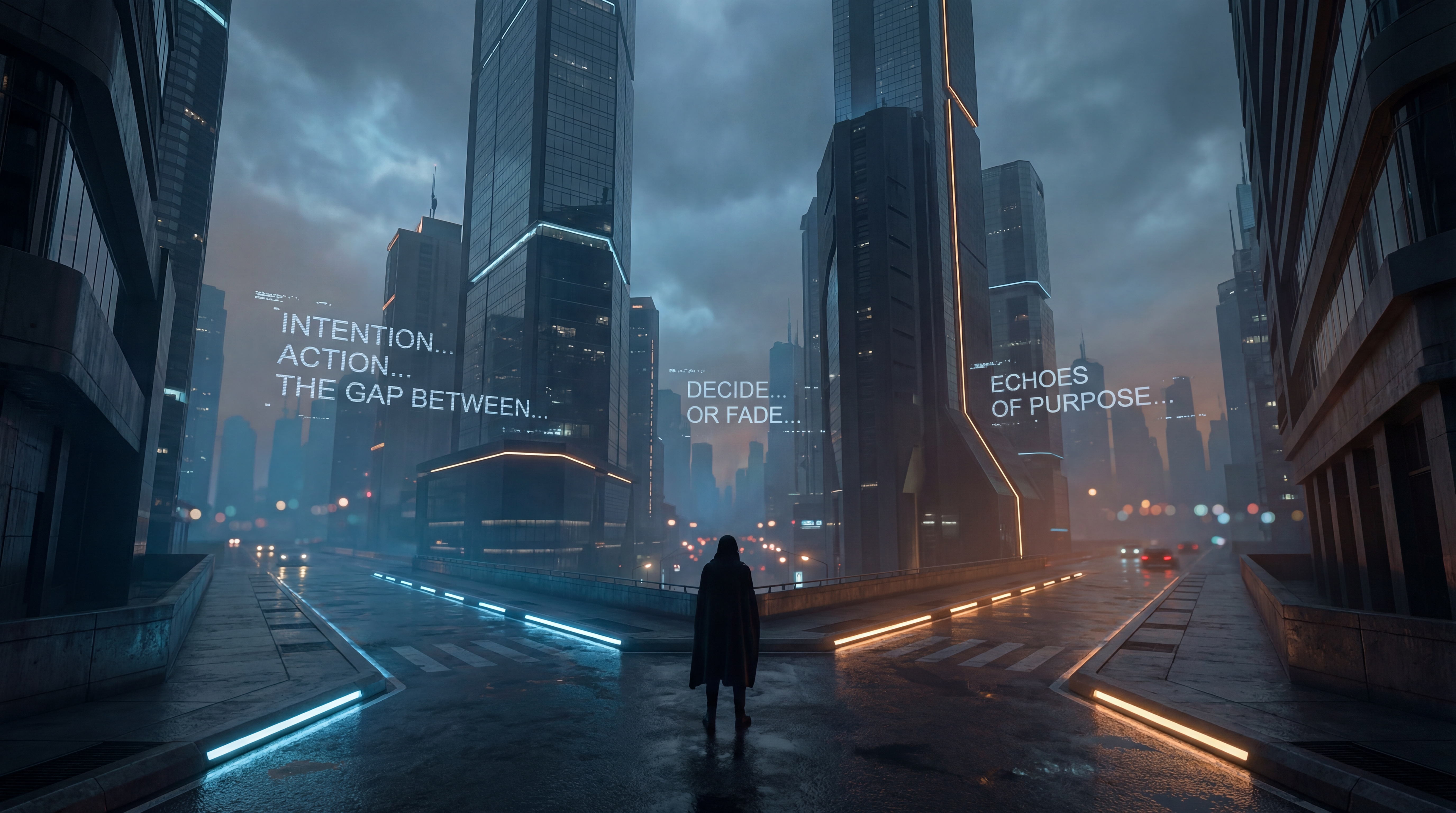
Why are we okay with not having the answers? Or are we? Maybe it's because certainty is an illusion. It gives the appearance of control when in fact we're all just navigating this vast sea of chaos without a map, without a GPS, only our questions as oars. There's freedom and terror in that realization. So, we could say the "why" is our compass, pointing in all directions but never settling on one.
And I guess that's where I'm leaving it for now, I've got some new questions spinning in my mind. What if asking endlessly is its own form of creation? Like, crafting something not from answers but from an evolving landscape of endless inquiries? Could be the next thing to dive into, probably something I'll explore when I'm, once again, stuck in that loop of questions.
